

Archbishop Makarios of Australia visited the Parish of Saint Demetrios in St Marys, Sydney



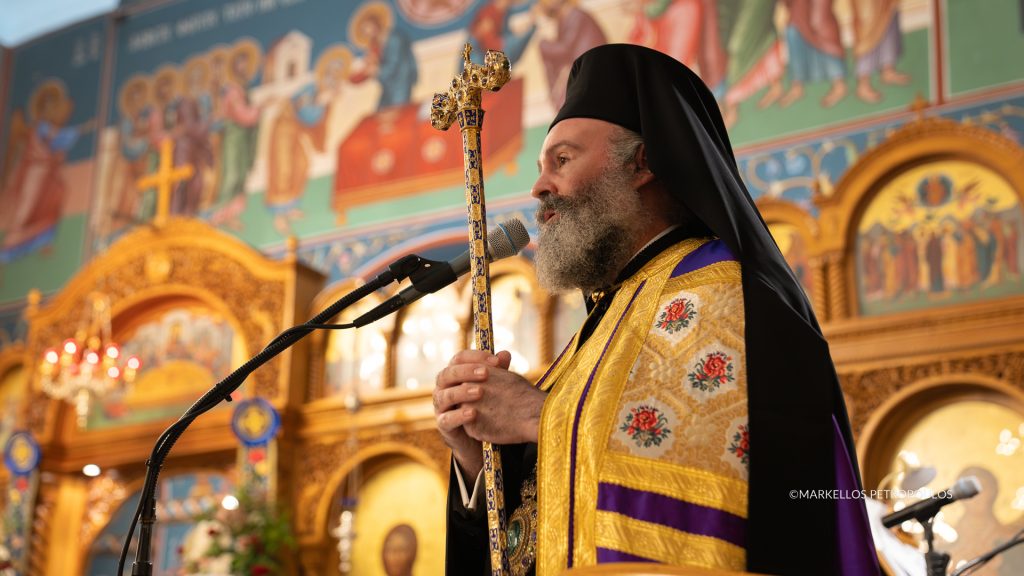
His Eminence Archbishop Makarios of Australia celebrated the Divine Liturgy on the morning of Sunday, 1 November, at the crowded Church of Saint Demetrios, in the Sydney suburb of St Marys. His Eminence received a warm welcome from the devout faithful of the Parish and reciprocated with heartfelt paternal wishes, invoking the intercessions of the Holy Great Martyr Demetrios for their protection and sanctification, as well as that of their families.
During his sermon, he presented and theologically analysed the parable of the Rich Man and the Poor man Lazarus (Luke 16:19–31), from the Gospel reading of the day. Focusing on the deeper message of the parable, he clarified that neither wealth nor poverty constitutes, in itself, a criterion for our salvation, but rather that salvation depends on our attitude towards God and our fellow human beings. “The rich man is not condemned because of his wealth,” he observed, but because “he was indifferent and hard-hearted towards poor Lazarus and towards every fellow human being who was in need.”
“It is not wealth itself that condemns the rich man,” he pointed out, “but his hard-heartedness, his indifference towards his neighbour and his refusal to offer even the slightest assistance to someone in need.” Similarly, regarding the poor man Lazarus, he observed that “not a single word of protest against God comes from his mouth; he does not complain, he does not speak against the hard-hearted rich man, and he endures his tormenting daily existence without a single complaint.” He therefore explained that “neither is poverty itself what secures the Kingdom of God for the poor man, but rather the disposition of his heart, the patience and endurance with which he faces his sufferings.”
In conclusion, Archbishop Makarios emphasised that “the circumstances of life, wealth or poverty, health or illness, fame and glory or obscurity and insignificance, are not absolute criteria for the salvation of our souls.” “The great question is how each person positions themselves and responds to all of the above,” he stressed, continuing: “If material possessions are used with thanksgiving to God and with a willingness to benefit our fellow human beings, they ultimately become a source of sanctification and salvation. If, however, their use leads us to indifference towards our fellow human beings, then they become a cause of condemnation. “Likewise, if the difficulties and misfortunes of life become occasions for prayer, patience, endurance and the glorification of God’s name, rather than causes of murmuring and blasphemy, then we proceed safely along the path of salvation.”
Concluding his address, His Eminence spoke to the congregation with paternal words of love, expressing the unwavering support of the Holy Archdiocese for the Parish of Saint Demetrios and calling upon everyone to work together in unity for its further progress. “My wish and appeal to everyone is that we may have unity and love, and that we may all struggle together, not for ourselves, but for the glory of Christ and of our Greek people,” he noted, among other things.
At the conclusion of the Hierarchical Divine Liturgy, a procession took place with the Holy Icon and Holy Relic of the Patron Saint of the Parish, Saint Demetrios the Myrrh-streamer. This was followed by the annual Greek Festival, which included a cultural programme, traditional Greek delicacies and a wide range of activities for both young and old.


Τα σχόλια είναι κλειστά.